
5F, W2, Chengxin Building , Tian An Shen Chuang Valley Industrial Center, Fenggang Town, Dongguan City, Guangdong Province,China 523681
Views: 0 Author: Site Editor Publish Time: 2026-11-23 Origin: Site


Physical limits often dictate exactly where security cameras can reside on a large property. You hit a hard physical wall at 100 meters, or roughly 328 feet, when running standard Ethernet lines from a central network switch. Pushing past this invisible barrier requires smart engineering and the right inline equipment. System integrators and property owners desperately need reliable, long-haul power delivery for modern, high-draw PTZ or AI-powered cameras. However, you must avoid the logistical nightmare of trenching new AC power lines across paved parking lots. You also want to avoid splicing fragile fiber optics underground, as these traditional workarounds create immense installation complexity and drain deployment budgets quickly. This article provides a thorough technical evaluation of using targeted extension devices versus alternative networking methods. You will learn how to accurately calculate system power budgets, understand strict wire gauge realities, and ensure long-term outdoor stability for your surveillance grid.
A high-quality POE extender safely doubles standard Ethernet distance while maintaining 100Mbps speeds, suitable for 4K and AI-driven camera streams.
Every extender in a chain consumes a parasitic power load (typically ~5W); strict power budget calculations are non-negotiable.
Line resistance matters: Long-distance deployments require upgrading your PoE cable to 16 AWG or 14 AWG pure copper to prevent terminal voltage drop.
For mixed deployments (e.g., one PTZ and one fixed dome), a 90W PoE injector paired with a 1-in-2-out outdoor extender often provides the highest ROI.
Extending an IP camera network typically forces engineers to evaluate four distinct options. You could trench local AC power to the remote site, install secondary switches in climate-controlled utility boxes, lay complex fiber optics, or simply deploy a dedicated inline POE Extender. Laying fiber or bringing in a certified electrician to wire 110V/220V power requires heavy manual labor, strict municipal permits, and expensive raw materials. By leveraging existing twisted-pair copper infrastructure, you bypass these heavy capital expenditures entirely. You keep the project scope manageable and deployment timelines short.
Many installers initially gravitate toward wireless bridges for wide-open spaces. They promise clean point-to-point data transmission without breaking ground or renting trenching equipment. However, environmental factors ruthlessly expose their core vulnerabilities. Heavy seasonal rain, dense coastal fog, and aggressive foliage growth easily obstruct line-of-sight microwave signals. Signal degradation triggers dropped frames and missed recording events. Conversely, an underground or conduit-protected wired run provides unshakeable, continuous uptime. Hardware physically buried in PVC pipe does not care about bad weather overhead. It delivers guaranteed packet delivery regardless of atmospheric conditions.
During hardware selection, you might notice cheap network switches offering a physical "VLAN/Extend" DIP switch on the front panel. Manufacturers claim these switches push data up to 250 meters. There is a massive, often undocumented catch. Flipping this switch forcefully throttles your port bandwidth down to a mere 10Mbps. This severely crippled data rate cannot handle modern security needs. Streaming a 30fps 4K video feed or transmitting high-bitrate AI facial recognition data demands a steady 100Mbps connection to function flawlessly. Proper extension hardware maintains full bandwidth across the entire extended run, ensuring your intelligent cameras operate at peak performance without artificial bottlenecks.
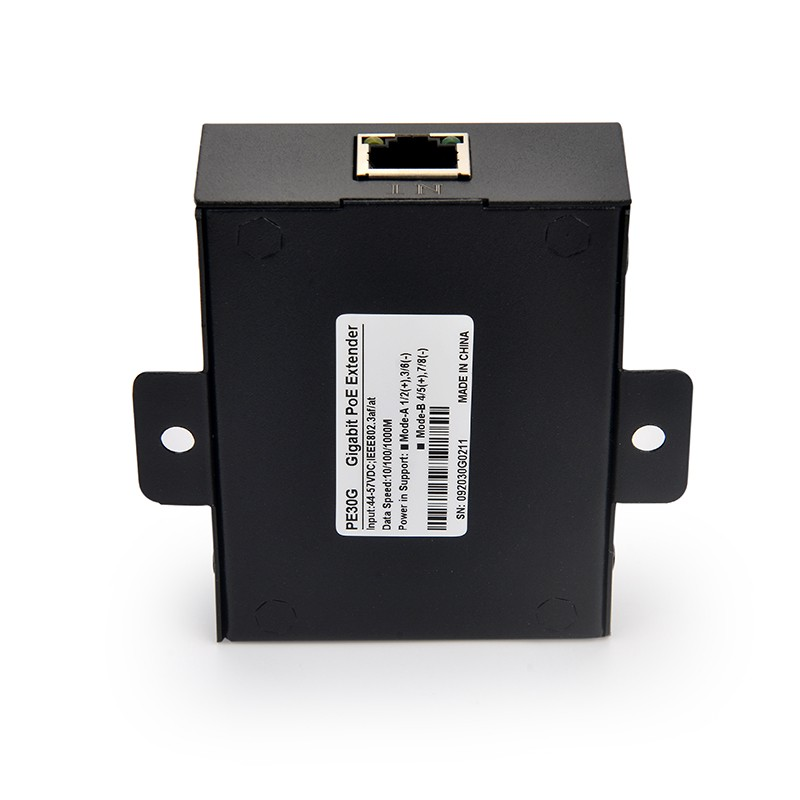
Electrical power does not travel down a wire for free. An active extension device functions as an intelligent signal repeater. It draws approximately 5W just to power its own internal processing circuitry. It then passes the remaining wattage down the line to your destination camera. If your primary switch sends out 50W of power, the first repeater immediately consumes 5W. You now have 45W of usable output remaining. You must meticulously account for this 5W dissipation tax during your initial planning phase. Failing to calculate this parasitic load leaves your terminal equipment starving for electricity.
Compatibility traps ruin many otherwise perfect installations. A frequent industry mistake involves mismatching older 24V DC passive devices with modern enterprise equipment. Modern security cameras universally expect a 48V active handshake based on IEEE 802.3af or 802.3at protocols. The camera and the switch digitally negotiate the power delivery before sending the full load. A passive 24V unit blindly pushes continuous direct current down the line without this safety handshake. This voltage mismatch will fail to boot the camera and frequently damages the camera's delicate internal network interface. Always insist on strict IEEE standards compliance for any enterprise hardware deployment.
Standard network switch ports often max out at 30W of output. This standard allocation easily falls short during ultra-long runs with heavy cameras. Instead of relying on a weak switch port, you can bypass the switch's power delivery entirely. You simply inject raw power mid-span using a dedicated, high-capacity 60W or 90W PoE Injector. This strategic component guarantees ample wattage reaches your terminal device. It leaves plenty of overhead for the repeater's parasitic load, line resistance loss, and the camera's heavy startup draw when infrared arrays engage at night.
The physical layer ultimately dictates your installation's long-term success. Standard Cat5e wire performs admirably within normal indoor office environments. However, it often fails miserably in ultra-long-distance exterior setups. Thin wire introduces high electrical resistance. Over hundreds of meters, this resistance converts your precious electricity into useless ambient heat along the copper run.
Wire thickness directly controls the severity of terminal voltage drop. We measure this critical thickness in AWG (American Wire Gauge). Lower numbers indicate a significantly thicker physical wire. If you attempt to push high wattage through a thin 18 AWG copper wire over 300 meters, you will witness a massive voltage drop at the far end. The camera might receive enough power to turn on, but the moment its mechanical PTZ motors or infrared lights trigger, the voltage dips below operational thresholds. These frustrating boot loops demand a physical infrastructure upgrade. You must shift to thicker 16 AWG or even 14 AWG THWN-2 twisted pair wiring for extreme distances.
Validating your chosen PoE Cable remains absolutely paramount. You must never use copper-clad aluminum (CCA) for powered network lines. CCA wire features a brittle aluminum core thinly coated in a microscopic layer of copper. It exhibits terrible electrical resistance metrics and literally melts under heavy continuous electrical loads. You must exclusively deploy solid pure bare copper (BC). Pure copper ensures highly stable power delivery without catastrophic overheating, even under peak summer temperatures.
To visualize how wire gauge impacts long-distance deployment safety, review the following resistance and performance chart:
Wire Gauge (AWG) |
Conductor Material |
Suitability for >300m Runs |
Risk of Voltage Drop |
|---|---|---|---|
24 AWG (Standard Cat5e) |
Pure Copper |
Poor |
Extremely High |
18 AWG |
Pure Copper |
Moderate |
High (Boot Loops Likely) |
16 AWG |
Pure Copper / THWN-2 |
Excellent |
Low |
14 AWG |
Pure Copper / THWN-2 |
Superior |
Negligible |
Network topologies become critical engineering variables when extending beyond standard physical limits. You cannot simply chain hardware together indefinitely without understanding the underlying signaling physics.
Here are three primary deployment topologies engineers utilize in the field:
Daisy-Chaining Deployments: You face strict physical limits when linking devices in a row. You can typically chain a maximum of two to three units together. Pushing beyond three consecutive hops causes significant data packet latency. Cumulative power dissipation also compounds rapidly across each node, degrading the final electrical signal below minimum operational thresholds.
1-in-2-Out Splitter Configurations: This advanced topology solves single-cable multiplexing challenges beautifully. You trench one heavy-duty backbone line out to a remote parking lot pole. At the pole, a specialized multiport unit splits both power and data streams. You can simultaneously drive a heavy 30W PTZ tracking unit and a lighter 15W fixed bullet camera from that single backbone line, saving massive labor costs.
Ultra-High Power (PoE++) Applications: Modern surveillance architectures require massive wattage. Emerging 120W models handle these extreme industrial requirements. They safely power complex IoT matrices, multi-sensor 360-degree surveillance housings, and integrated outdoor enclosures equipped with heavy internal heaters and defroster blowers.
These topology choices heavily influence your initial hardware selection. Planning a multiplexed layout upfront prevents expensive rework if you later decide to add a second camera to a remote pole.
Mother Nature destroys unprotected electronics with alarming speed. Deploying networking gear outdoors demands rigorous physical safeguards and protective planning. You must insist on hardware featuring IP67-rated enclosures. These tight seals block microscopic dust intrusion and easily withstand temporary submersion in heavy floodwaters. Hardened industrial temperature ratings ensure continuous operation during freezing winter storms and blistering summer heatwaves. Furthermore, ruggedized waterproof cable glands protect the highly vulnerable insertion points where copper lines enter the metal housing.
Outdoor copper lines easily act as giant lightning rods. A nearby lightning strike induces massive electrical spikes that travel rapidly down the line toward your server room. You face a critical implementation risk here. You must install dedicated surge protectors at two highly specific locations. Place the first protector directly at the remote camera edge. Place the second protector directly at the main building entry point. This dual-layered grounding approach effectively shields your core network switches from catastrophic external electrical surges.
Sometimes, you inherit older environments containing legacy wiring. Ethernet over Coax (EOC) serves as an excellent fallback solution in these tricky scenarios. If an environment boasts existing high-quality coaxial cable from an analog CCTV era, pulling new twisted pair feels highly inefficient. EOC adapters successfully reuse this legacy infrastructure. It often proves far cheaper and faster than boring through solid concrete walls just to run fresh twisted pair cables.
When handling these physical implementation realities, system integrators should follow these critical best practices:
Always mount equipment enclosures with cable glands pointing strictly downward to prevent rainwater pooling along the seals.
Secure a dedicated, thick earth ground wire directly to the mounting pole or metal chassis to route surge energy safely away.
Apply specialized dielectric grease to all exterior RJ45 connections to aggressively fight long-term moisture corrosion.
Thoroughly audit all legacy coax lines for hidden impedance mismatches before deploying EOC adapter units.
A properly deployed POE Extender architecture serves as a highly effective, cost-efficient solution for bridging the frustrating 100-meter to 500-meter physical networking gap. It delivers flawless data and power performance provided you respect the strict underlying physics. You must meticulously maintain your system power budgets and utilize the appropriate, heavy-duty wire gauge for the environment.
Your actionable next steps include three specific audits. First, carefully audit your selected camera's absolute maximum power draw. Always measure peak wattage requirements at night when the infrared arrays engage and internal defroster heaters activate. Second, measure your exact cable run distance physically using a rolling wheel. Do not guess the distance based on outdated building blueprints. Finally, select extension hardware fully compliant with the appropriate IEEE 802.3at/bt standard to ensure a safe, active digital handshake across your entire network segment.
A: An injector simply adds necessary electrical power to a standard, non-powered data line coming from a basic network switch. It originates the power on the line. Conversely, an extender acts as an inline repeater mid-span. It actively takes existing power and data, boosts the signal integrity, and repeats both elements well beyond the standard 100-meter physical limitation.
A: No. You face strict physical constraints. Each unit in the chain consumes a small amount of parasitic power for itself, leading to rapid terminal voltage drop. Furthermore, every hop introduces slight data transmission latency. Due to these accumulating signal and power degradations, engineers typically cap field installations at two to three consecutive hops.
A: A high-quality device maintains the full 100Mbps or 1000Mbps bandwidth across the entire extended distance perfectly. However, cheap network switches relying on a physical "extend mode" DIP switch will forcefully downgrade your connection to 10Mbps. This severe bandwidth throttle easily chokes high-bitrate 4K streams and advanced AI video analytics.


