
5F, W2, Chengxin Building , Tian An Shen Chuang Valley Industrial Center, Fenggang Town, Dongguan City, Guangdong Province,China 523681
Views: 0 Author: Site Editor Publish Time: 2026-11-09 Origin: Site


Network administrators know the terrifying reality of "magic smoke." You plug a cable into a port, and instantly, a network interface card (NIC), an expensive smart board, or a core switch burns out. This catastrophic failure often happens due to improper Power over Ethernet (PoE) connections.
The convenience of delivering data and power over a single cable is undeniable. However, this convenience introduces hidden voltage risks. The danger multiplies when you mix non-standard equipment, legacy IT assets, and different types of a PoE Converter. Misunderstanding how these devices negotiate power can turn a simple network upgrade into a costly disaster.
Preventing hardware failure requires moving beyond basic compatibility checks. It demands strict adherence to IEEE standard auto-sensing protocols. You must enforce rigorous physical deployment safeguards. Ultimately, building a resilient network relies on choosing the right modules and injectors based on active negotiation principles.
Passive vs. Active Risk: "Passive" PoE converters continuously output voltage (often 24V or 12V), which is the primary cause of fried non-PoE devices. "Active" PoE converters use a safety handshake before delivering power.
The 3-Stage Handshake: Standardized IEEE 802.3af/at/bt devices prevent damage by probing for compatibility using a low-voltage pulse before initiating power transmission.
Human Error Mitigation: Catastrophic damage often stems from reverse-plugging (sending powered output into a non-PoE switch) or misconfiguring smart switch ports.
Deployment Protocol: Safe PoE rollouts require physical labeling, port-level management policies, and utilizing PoE splitters for legacy endpoints.
Procurement teams often default to low-cost "PoE bricks" to save budget. They do this without fully understanding the underlying power delivery mechanisms. This lack of awareness leads to unpredictable hardware lifespans. Networks become minefields where a single mispatched cable destroys high-value hardware.
Passive PoE modules push a constant electrical current over the network cable. They usually send this voltage across specific wire pairs, such as pins 4/5 and 7/8. They operate blindly. They deliver power regardless of what you plug into the other end.
This "dumb" power delivery creates a massive risk. Imagine inserting a standard laptop, a smart display, or a legacy switch into a passive line. You subject highly sensitive microprocessors to unnegotiated voltage immediately. The endpoint hardware cannot reject the current. The unexpected electricity races through the internal circuitry. This causes localized overheating, melts small pathways, and leads to permanent component burnout.
Active PoE eliminates this risk through intelligent design. It relies on a rigorous fail-safe mechanism known as the three-stage power handshake. Active switches and converters refuse to send high voltage until they verify the endpoint can handle it.
Detection: The Power Sourcing Equipment (PSE) tests the line. It sends a harmless, tiny 2-10V pulse down the Ethernet cable. It looks for a valid signature resistance (typically 25k ohms) from the endpoint.
Classification: Once the PSE detects a compatible device, it evaluates the exact wattage requirements. The Powered Device (PD) signals its power class. This tells the PSE exactly how much power to allocate.
Operation: The PSE only initiates the full 48V+ power flow if the previous two stages confirm absolute compatibility. If it detects a non-PoE device, such as a standard laptop, it blocks the power completely. It will only pass data.
Even seasoned IT professionals make mistakes when handling PoE infrastructure. Understanding how failures happen in the real world helps you design better physical safeguards. Let us examine three common deployment disasters.
Field technicians frequently work in dark, cramped wiring closets. In a rush, a technician might accidentally route the "Power + Data" output of an injector backward. They mistakenly plug this live output into the standard uplink port of a non-PoE management switch.
The result is instant and devastating. Direct voltage injects straight into the switch backplane. Standard switch ports lack electrical isolation against incoming 48V streams. The port fries immediately. In many cases, the electrical surge destroys the entire switch motherboard.
Sometimes, engineers manually override standard PoE settings in a managed switch operating system. They do this to support legacy passive endpoints. For example, they might force a port into 24V passive mode to power an older radio antenna.
This implementation reality creates a ticking time bomb. The port becomes a permanent hazard. If someone later removes the antenna and plugs a standard device into that wall drop, the forced passive voltage destroys the new device.
Deploying equipment outdoors introduces unpredictable environmental variables. Teams often install a network module outdoors without adequate surge protection. They trust the basic plastic casing to protect the electronics.
Power surges from lightning strikes or grid fluctuations amplify over the copper Ethernet line. These surges bypass standard internal protections. The resulting energy spike destroys both the converter and the connected endpoint camera or sensor.
Failure Scenario | Root Cause | Resulting Damage | Prevention Method |
|---|---|---|---|
Reverse-Plug | Human error during patching. | Fried switch backplane or port. | Color-coded cables and clear port labeling. |
Forced Passive Mode | Software override of auto-sensing. | Burnout of newly connected standard devices. | Disable passive modes; use external adapters for legacy gear. |
Outdoor Surges | Lack of environmental electrical shielding. | Complete hardware destruction via grid spikes. | Inline surge protectors and shielded Cat6 runs. |
Protecting your network starts at the procurement phase. You must evaluate hardware based on strict technical capabilities rather than just price. Using the right evaluation dimensions prevents hazardous equipment from entering your environment.
You should only shortlist equipment explicitly rated for IEEE standards. Look for 802.3af (15W), 802.3at (30W), or 802.3bt (60W/90W) certifications. These standards guarantee the inclusion of the auto-sensing handshake.
Treat labels like "proprietary PoE" or "passive adapter" as immediate disqualifiers for enterprise environments. Uncertified hardware bypasses safety checks. It puts every connected endpoint at risk of unexpected voltage delivery.
Ensure the Power Sourcing Equipment exactly matches the endpoint requirement. Pushing high-wattage Type 3 or Type 4 power demands excellent infrastructure. You cannot use old Cat5e cables for 90W power delivery safely.
High power requires properly gauged, shielded cabling like Cat6 or Cat6a. Thicker copper conductors mitigate thermal rise inside the cable bundles. Without proper cabling, the wires can overheat. This leads to cable melting, severe signal degradation, and potential fire hazards.
Your deployment scale dictates the hardware form factor you should choose. Using the wrong form factor increases physical clutter and invites human error. Follow a strict shortlisting logic.
Use a single PoE Injector for isolated endpoint additions. For example, injecting power for one remote IP camera makes sense. However, transition to an active PoE hub or switch when scaling past three or four devices. Consolidating power into a managed switch minimizes cable clutter. It dramatically reduces the potential for technicians to cross-patch active lines into incorrect ports.
1-2 Devices (Remote Location): Single Port Injector.
3-5 Devices (Centralized): 5-Port Unmanaged Active Switch.
6+ Devices (High Value Endpoints): Fully Managed Active Switch with port-level power controls.
Organizations often struggle with integrating older technology into modern networks. You might need to power legacy, non-PoE devices using your existing active infrastructure. You cannot just plug a powered Ethernet cable into them. This is where a splitter becomes invaluable.
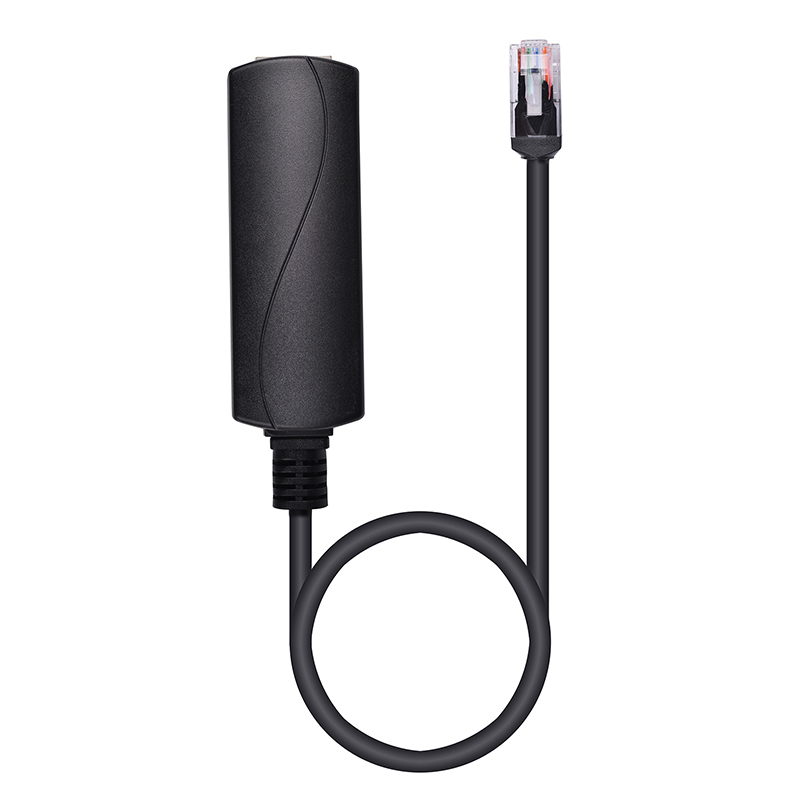
Instead of injecting power into the line, a splitter sits at the end of the cable run. It acts as the intelligent endpoint. The splitter safely negotiates power with the active PSE in the telecom closet. It performs the required handshake to open the 48V power flow.
Once it receives power, the splitter separates the connection. It outputs a standard RJ45 data line and a separate DC barrel plug. You then plug the data line into the legacy device's network port. You plug the DC barrel into the device's power port.
This deployment safely brings specialized hardware onto a modern network. You can integrate point-of-sale systems, biometric security scanners, or legacy VoIP phones seamlessly. The splitter handles the voltage conversion. It completely shields the endpoints' internal circuitry from the network's 48V power pool.
Even with standard-compliant hardware, physical installation requires discipline. Cabling teams must adopt fail-safe workflows to protect the infrastructure. Relying solely on hardware auto-sensing is a dangerous gamble in mission-critical environments.
Human error accounts for a massive portion of blown hardware. If you absolutely must use a passive injector run for legacy equipment, you need physical warnings. Apply high-visibility red warning tags on both ends of the required cable run.
Treat this specific port as a live electrical hazard. Anyone looking at the patch panel must instantly recognize that unplugging this cable and moving it elsewhere could cause a fire or fry a switch. Visual cues stop technicians before they make a fatal patching mistake.
You must protect high-value, non-PoE infrastructure proactively. Core servers and edge firewalls cost thousands of dollars. Do not rely entirely on the switch's auto-sensing mechanism to protect them.
Proactively log into the switch management interface. Locate the specific ports connecting to these critical endpoints. Permanently set the power delivery to "Disabled" for those specific interfaces. This software quarantine removes any chance of an accidental power burst if the switch reboots or firmware malfunctions.
Field installations happen under pressure. Do not mount expensive hardware before testing the line. Mandate a strict workbench test protocol for your engineering team.
Connect your chosen PoE Module in a safe testing environment first. Test the line with a dedicated tester or a digital multimeter. Verify the active handshake status. Ensure the voltage delivery matches the endpoint specifications exactly. Only after successful validation should technicians hard-mount expensive endpoints like PTZ cameras or Wi-Fi 6 access points to the ceiling.
Managing network power requires precision, standardized hardware, and a deep understanding of voltage risks. The cost of replacing a fried network interface card or a blown core switch is immense. The financial and operational damage far exceeds any marginal savings gained by buying cheap, passive adapters.
Standardize your procurement strategy strictly around IEEE 802.3 active converters. Never compromise on the three-stage power handshake. Combine compliant hardware with rigorous port-management policies and physical labeling. By executing these practices, you build an IT environment that is highly immune to accidental hardware burnout and operational downtime.
A: It depends on the injector type. If it is an Active (IEEE 802.3 compliant) injector, no. It will auto-sense the laptop, realize it does not require power, and only send data. If it is a Passive injector, yes. It will force raw voltage into the port, likely causing permanent, immediate damage.
A: You should never do this with a powered line. Connecting the powered output side of an injector directly into a standard switch uplink port forces voltage into an unprotected backplane. This action frequently results in catastrophic electrical damage to the switch.
A: "Converter" is a broad umbrella term for external devices that alter power states, including injectors and splitters. A "Module" typically refers to an embedded component or a modular power supply unit. Engineers slot these modules directly into enterprise switch chassis to enable native capabilities.


