
5F, W2, Chengxin Building , Tian An Shen Chuang Valley Industrial Center, Fenggang Town, Dongguan City, Guangdong Province,China 523681
Views: 0 Author: Site Editor Publish Time: 2026-10-23 Origin: Site


Expanding network infrastructure often requires mixing legacy hardware alongside modern networking switches. This hybrid integration makes Power over Ethernet (PoE) adoption a critical point of failure. Choosing the wrong power source or misinterpreting delivery standards brings severe consequences. It can easily result in catastrophic equipment burnout, prolonged network downtime, and voided manufacturer warranties. You cannot afford to guess when pushing raw voltage through your data cables. We designed this guide to provide network engineers and IT buyers a clear, vendor-neutral evaluation framework. You will learn how to safely compare active versus passive PoE solutions. We will help you navigate proprietary voltages and prevent costly compatibility risks. By mastering these core concepts, you can protect your hardware investments and ensure reliable network performance across all deployments.
Negotiated vs. Always-On: Active PoE relies on IEEE-compliant "handshakes" to guarantee safe power delivery, whereas Passive PoE forces a continuous, unnegotiated voltage down the line.
The Burnout Risk: Plugging a standard non-PoE device into a passive PoE source is a primary cause of port frying and hardware destruction.
Legacy Ecosystems: Passive PoE remains relevant strictly for specific proprietary ecosystems (e.g., older Ubiquiti or MikroTik deployments) and cost-sensitive, closed-loop environments.
Bridging the Gap: Deploying the correct PoE converter, PoE injector, or PoE splitter is critical for safely integrating incompatible voltages and pinouts in hybrid networks.
Understanding how power travels across your network cables is the first step in preventing hardware damage. The industry divides power delivery into two distinct categories: active and passive. They operate on entirely different mechanical principles.
Network professionals universally recognize Active PoE as the industry gold standard. It operates strictly under standardized protocols governed by the Institute of Electrical and Electronics Engineers (IEEE). These standards include IEEE 802.3af (standard PoE), 802.3at (PoE+), and 802.3bt (PoE++). When you use an active system, the power sourcing equipment (PSE) communicates with the powered device (PD) before sending high voltage.
This communication relies on a brilliant fail-safe mechanism known as the intelligent handshake. The handshake completes four mandatory steps before full power delivery begins:
Detection: The power source sends a harmless, low-voltage pulse down the Ethernet cable. It checks if the connected endpoint supports IEEE-compliant PoE.
Classification: Once the source detects a valid device, it sends a slightly higher voltage. It asks the endpoint how much wattage it requires to operate safely.
Power-Up: The power source incrementally ramps up the voltage. This prevents sudden electrical surges from damaging sensitive internal components.
Power Delivery: The system reaches the requested operating voltage. It then actively monitors the connection. If the device disconnects or short-circuits, the source immediately cuts the power.
This handshake acts as an ultimate fail-safe. If you accidentally plug a standard non-PoE laptop into an active port, the switch refuses to send power. The port simply transmits data, keeping your hardware perfectly safe.
Passive PoE operates as a fixed-voltage power supply. It completely lacks the intelligent negotiation protocol found in IEEE standards. When you plug a device into a passive source, power flows immediately. The source continuously transmits electricity over the Ethernet cable, regardless of the endpoint device's status.
You might wonder why manufacturers ever adopted this risky methodology. Historically, networking brands used passive delivery to bypass expensive IEEE certification costs. It also allowed them to reduce the internal power consumption of outdoor access points and radios. While it lowered manufacturing expenses, it shifted the burden of safety entirely onto the network engineer.
Common Mistake: Assuming all PoE ports are smart. Never plug an untested device into a port unless you explicitly confirm it utilizes an active, IEEE-compliant standard.
Hybrid networks often feature a mix of modern active switches, older non-PoE routing hardware, and legacy passive endpoints. You must bridge these gaps safely. Network engineers rely on three primary hardware devices to adapt power signals across incompatible network segments.
You will frequently encounter situations where you need to connect a PoE security camera to a legacy, non-PoE switch. A PoE Injector solves this exact problem. It sits mid-span between the network switch and the endpoint. The injector receives a standard data connection, injects DC power into the copper pairs, and outputs a combined power-and-data signal. This allows you to support modern endpoints without replacing your core routing hardware.
Sometimes you face the opposite problem. You might have a powerful modern PoE switch, but you need to connect an older non-PoE device, such as a legacy access control panel. A PoE Splitter handles this task at the edge of the network. It receives the combined signal from the switch. It then splits the signal back into two distinct cables: a standard Ethernet cable for data and a dedicated DC barrel plug for power.
The most complex scenarios involve voltage mismatches. You might have a 48V Active PoE switch, but you need to power an older 24V passive outdoor antenna. Connecting them directly would destroy the antenna. A inline PoE Converter safely steps up or steps down the voltage between the devices. These converters translate an active signal into a specific passive requirement, securely bridging incompatible network segments without forcing costly infrastructure overhauls.
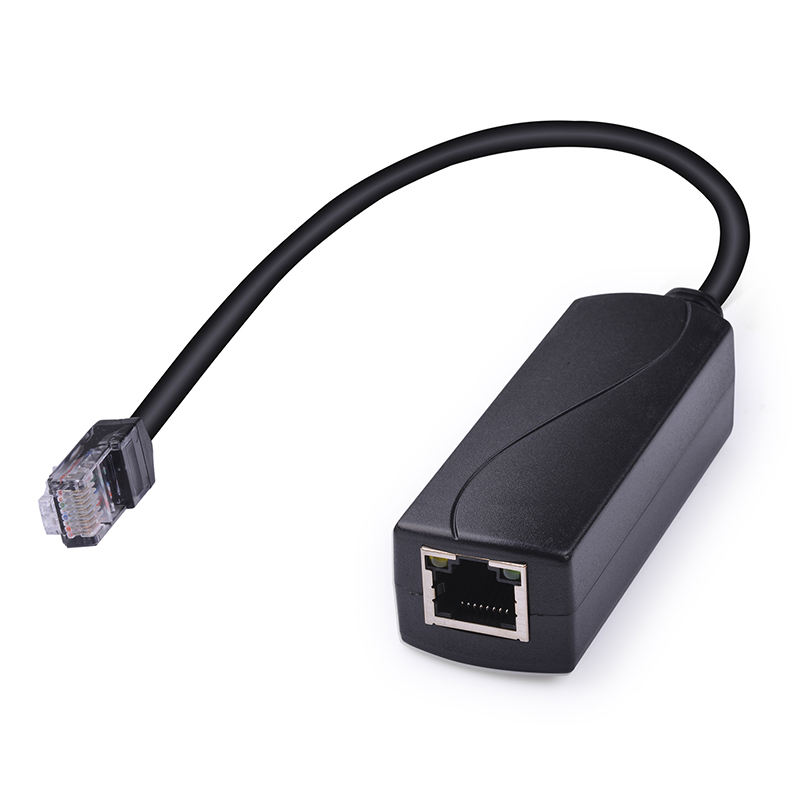
Deploying power across Ethernet cables involves substantial electrical risk. Hybrid environments compound these dangers. When you mix different vendor ecosystems, you must navigate three distinct layers of compatibility risks.
Introducing passive power into a hybrid network creates immediate danger. Because passive sources lack a handshake mechanism, they blindly send 24V or 48V into whatever device you connect. If you plug a standard laptop, a non-PoE switch, or a delicate smart TV into an active passive port, you will likely destroy the network interface card (NIC). In severe cases, the raw voltage travels past the NIC and permanently fries the device's motherboard. Network engineers call this "letting the magic smoke out."
Even if both devices expect power over their Ethernet cables, they must agree on the voltage. Standard Active PoE ecosystems typically operate at 44 to 57V DC. Conversely, many legacy Passive ecosystems operate strictly at 24V DC. If you send 48V into a 24V device, you will instantly overpower its internal regulators and destroy it. If you send 24V into a 48V device, it will suffer from underpowering. It may continuously reboot, drop network packets, or fail to boot entirely.
Ethernet cables contain eight individual copper wires, twisted into four pairs. Active systems utilize standardized data and power pair alignments (known as Mode A or Mode B). Passive systems, however, often rely on highly specific, vendor-dictated pinouts. For example, a manufacturer might send positive voltage exclusively over pins 4 and 5, while returning negative voltage over pins 7 and 8. If you use an incorrect crossover cable or a mismatched adapter, you can instantly short-circuit the connection. Verifying pinout diagrams is a mandatory step before deployment.
Electrical safety requires accurate mathematical planning. You cannot build a reliable network if you constantly exceed your power budgets or use inadequate cabling.
When you deploy passive infrastructure, you must calculate your power requirements manually. You must verify the endpoint device receives the exact wattage it needs to function. Use the universal formula for evaluating these requirements: Volts (V) × Amps (A) = Watts (W).
For example, if your legacy wireless access point requires 24V and draws 0.5A, it consumes 12 Watts of power (24V × 0.5A = 12W). You must ensure your power source can comfortably supply this wattage without maxing out its internal capacity.
Active networks simplify power planning significantly. The IEEE standards feature built-in downward compatibility. An advanced 802.3bt (PoE++) switch can safely power a basic 802.3af endpoint. The switch negotiates the connection and steps down its delivery to match the endpoint's exact needs. This backward compatibility largely removes the need for manual wattage calculations in pure active environments. You only need to track the total power budget of the switch itself.
Passive delivery suffers from severe voltage drop over long distances. Because copper wire contains natural resistance, voltage decreases as the cable gets longer. If you inject 24V at the switch, the endpoint might only receive 21V at the end of a 100-meter run. High-quality, pure copper cabling is strictly non-negotiable for passive deployments. Do not use cheap Copper Clad Aluminum (CCA) cables. To maintain consistent wattage and prevent random reboots, keep your passive cable runs well under 50 meters.
Choosing between active and passive solutions depends entirely on your specific business scenario. You must evaluate your risk tolerance, your existing hardware, and your deployment scale.
Feature | Active PoE (IEEE Standard) | Passive PoE (Non-Standard) |
|---|---|---|
Negotiation Protocol | 4-step smart handshake | None (Always-on) |
Typical Voltages | 44V – 57V DC | 12V, 24V, or 48V DC |
Safety Mechanisms | Overvoltage & short-circuit protection | No built-in port protection |
Device Compatibility | Universal plug-and-play | Requires exact voltage/pinout matching |
Scenario: You are building enterprise office networks, rolling out VoIP phone systems, or installing standard IP security cameras. Your environment features mixed IT equipment where employees frequently plug and unplug devices.
Business Logic: Active solutions minimize your liability. They guarantee true plug-and-play safety across the entire building. The built-in overvoltage and short-circuit protections ensure you will never accidentally fry an expensive laptop. For all modern corporate environments, active infrastructure is the only acceptable choice.
Scenario: You are managing legacy Wireless Internet Service Provider (WISP) deployments. You are installing dedicated radio antennas on a rural tower. You manage older sensor arrays, like early Ubiquiti airMAX or MikroTik outdoor access points.
Business Logic: Passive solutions remain acceptable strictly in controlled, closed-loop networks. Network engineers must carefully document every endpoint voltage. You must restrict physical access to the network ports. If you maintain strict administrative control over the cable runs, you can safely leverage passive hardware for these specific legacy applications.
Upgrading your network infrastructure requires careful attention to electrical standards. You can easily integrate new switches with legacy endpoints if you understand the underlying power mechanics. Keep these actionable takeaways in mind as you plan your deployment:
Default to Active PoE solutions whenever possible. They future-proof your infrastructure and effectively eliminate the liability of hardware damage.
Never guess when dealing with passive hardware. Always audit your existing endpoint device requirements, including voltage, wattage, and specific pinouts.
Avoid mixing environments directly. If you must bridge modern active switches to legacy passive endpoints, use dedicated inline voltage converters to handle the translation safely.
Invest in high-quality, pure copper cabling. This protects against voltage drops and ensures stable power delivery to edge devices.
Do not let a simple voltage mismatch derail your network upgrade. Audit your hardware datasheets today. We recommend consulting a technical sales representative or reviewing a detailed catalog of IEEE-compliant power conversion devices to secure your deployment perfectly.
A: Yes. Because it does not perform a compatibility check, it will send raw voltage into the device, frequently causing permanent hardware damage to the port or motherboard.
A: Only by using a specialized inline PoE converter that steps down/up the voltage and translates an Active PoE signal into the specific Passive PoE requirement of the endpoint.
A: Historically, it lowered manufacturing costs by avoiding IEEE certification and allowed for lower operational voltages (like 24V), which was ideal for outdoor access points and rural WISP infrastructure.
A: Check the device's datasheet. If it lists an IEEE standard (802.3af, 802.3at, or 802.3bt), it requires an Active device. If it simply states a strict voltage requirement (e.g., "24V Passive PoE"), it requires a matched Passive source or a dedicated converter.


