
5F, W2, Chengxin Building , Tian An Shen Chuang Valley Industrial Center, Fenggang Town, Dongguan City, Guangdong Province,China 523681
Views: 0 Author: Site Editor Publish Time: 2026-01-31 Origin: Site


Ever wondered how one cable powers cameras, phones, and Wi-Fi?
Modern networks demand speed and simplicity.That’s where a PoE injector changes everything.
It delivers power and data through one Ethernet line.In this guide, you’ll learn how it works, why IEEE safety matters, and when to use it.
A PoE injector is designed to insert electrical power into a standard Ethernet cable while allowing network data to pass through unchanged, which enables powered devices to operate using only one physical connection.
In most deployments, the PoE injector sits between a non-PoE network switch and a powered device, such as an IP camera or wireless access point. One port receives data from the switch, while the other sends combined data and power to the endpoint. This design is often called “midspan injection,” because power is added midway between the switch and the device.
Typical powered devices include security cameras, wireless access points, VoIP phones, access controllers, point-of-sale terminals, and information displays, all of which benefit from centralized power delivery.
Understanding the internal flow of electricity and data helps clarify how reliable PoE systems are built.
First, AC or DC power enters the PoE injector through its input connector. Inside the unit, a power conversion module transforms this input into regulated DC voltage suitable for PoE transmission. The injector then merges this DC power into specific wire pairs within the Ethernet cable while maintaining complete electrical isolation between the data circuitry and power circuitry.
Meanwhile, Ethernet signals pass through magnetic isolation transformers, which preserve signal integrity and prevent electrical noise from affecting network performance. Once the combined signal reaches the powered device, internal circuitry separates data from power, allowing the device to operate normally.
This architecture ensures that data remains clean and uninterrupted while power flows safely over distances of up to 100 meters using standard Cat5e or Cat6 cable.
Modern PoE injectors follow IEEE standards that require an intelligent detection process before any power is applied.
When a device connects, the injector sends a low-voltage probe signal to determine whether the endpoint supports PoE. If a compatible powered device responds, the injector classifies its power requirements and then begins delivering the appropriate voltage and current. If no PoE signature is detected, the injector remains inactive.
This handshake mechanism prevents accidental damage to laptops, printers, or other non-PoE equipment, which is why standards-compliant PoE injectors are safe to use in mixed networks.
PoE uses twisted pairs inside Ethernet cables to transmit power. Two common methods exist: Mode A and Mode B.
Mode A delivers power over the same pairs used for data transmission, while Mode B uses spare pairs found in older Fast Ethernet cables. Most modern injectors and devices support both modes automatically, which means installers rarely need to consider this detail during deployment.
Different devices require different power levels, and PoE standards define how much power can be delivered safely.
IEEE Standard | Maximum Power | Typical Applications |
802.3af | 15.4W | VoIP phones, basic cameras |
802.3at (PoE+) | 30W | PTZ cameras, Wi-Fi APs |
802.3bt | 60–90W | Displays, lighting, kiosks |
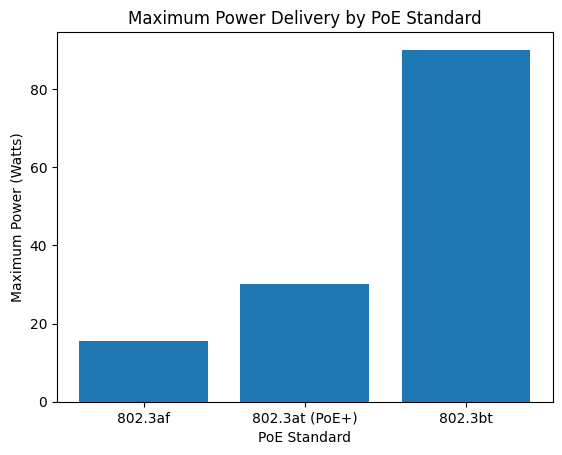
Choosing an injector with insufficient wattage often leads to unstable devices, random reboots, or failure to start, which is why power matching is a critical design step.
With an active PoE injector, nothing harmful occurs when a non-PoE device is connected. Because the injector waits for a valid PoE signature before delivering power, incompatible equipment simply receives data only, ensuring safety across the entire network.
A typical PoE injector contains several specialized modules that work together to ensure reliable operation.
The power supply module converts incoming AC or DC into regulated output voltage while maintaining efficiency and minimizing heat. Data pass-through circuitry preserves Ethernet signal quality using isolation transformers. Detection and control chipsets manage device classification, power negotiation, and real-time monitoring. Finally, thermal protection and overload safeguards prevent overheating, short circuits, and electrical faults, extending the lifespan of both the injector and connected devices.
These components explain why higher-quality PoE injectors tend to offer better stability, longer service life, and stronger protection in demanding environments.
PoE injectors excel in specific scenarios, especially when full PoE switches are unnecessary or impractical.
Single-device deployments such as one camera or one access point often benefit from injectors because they avoid the cost of replacing existing switches. Retrofit projects also rely heavily on injectors, allowing PoE upgrades without disrupting core infrastructure.
From a cost perspective, injectors usually provide a faster return on investment for small installations, while PoE switches make more sense for large or growing networks. Injectors are also popular for temporary or remote deployments such as construction sites, pop-up offices, and field installations where flexibility matters more than centralized switching.
Selecting the right PoE injector requires attention to power class, cable length, environmental conditions, and future scalability.
Power class matching is the first step, and professionals typically add at least 20 percent headroom to device requirements to ensure stability during peak load. Cable length also matters, since longer runs increase voltage drop, making Cat6 preferable for higher-power devices.
Indoor injectors focus on compact design, while outdoor models require IP-rated housings and surge protection. Single-port injectors suit simple projects, whereas multi-port units support small device clusters and gradual expansion.
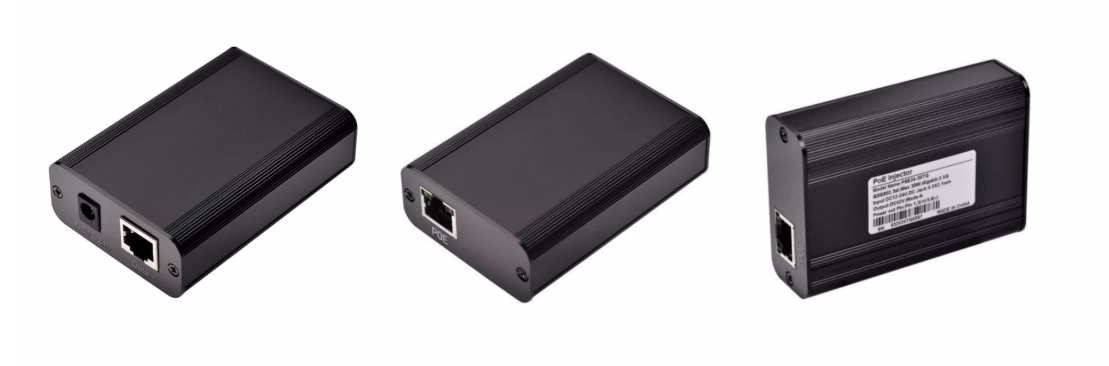
To see how these principles apply in practice, consider the SDaPo PSE24-30TG 1/2.5Gbps 30W PoE Injector, a compact single-port model designed for modern edge devices.
This injector supports IEEE802.3af/at standards and delivers up to 30W of power while maintaining full compatibility with 100M, 1G, and 2.5G Ethernet links, making it suitable for Wi-Fi 6 access points and high-resolution cameras.
Feature | Specification |
PoE Standard | IEEE 802.3af / at |
Maximum Output | 30W |
Input Voltage | 10–30V DC |
Output Voltage | 48–56V DC |
Network Speed | 100M / 1G / 2.5G |
Transmission Distance | Up to 100 meters |
Power Mode | Mode A (1/2 +, 3/6 -) |
Dimensions | 83 × 57.6 × 24.1 mm |
Operating Temperature | -20°C to 55°C |
Internally, the PSE24-30TG uses a detection chip to classify powered devices before delivering energy, ensuring that power is applied only after a compliant endpoint responds. Its plug-and-play design requires no configuration, making it easy to deploy in offices, retail spaces, and industrial cabinets.
Typical applications include IP cameras, wireless access points, VoIP phones, access control systems, displays, POS terminals, and information kiosks. Security integrators often deploy it for cameras and door locks, while IT teams use it to upgrade access points without replacing legacy switches.
PoE injectors simplify installations by reducing cabling, eliminating the need for nearby outlets, and enabling centralized power control. Technicians can reboot devices remotely by cycling injector power, which saves time and avoids ladders or ceiling access.
They also improve reliability by delivering stable voltage to edge devices, reducing random resets and downtime. For many organizations, PoE injectors form the foundation of cleaner infrastructure and easier maintenance workflows.
The most common PoE issues stem from mismatched power standards, poor cable quality, and inadequate ventilation.
Symptoms such as device reboots or failure to power on often indicate insufficient wattage or excessive voltage drop. Certified Cat5e or Cat6 cables should always be used, and injectors should be installed with adequate airflow to prevent thermal buildup.
A basic troubleshooting checklist includes verifying PoE standards, testing alternate cables, confirming device compatibility, and checking injector LEDs for status indicators.
Active PoE injectors follow IEEE negotiation rules, while passive injectors deliver power without detection. Passive designs can damage equipment and void warranties, which is why professional deployments always rely on IEEE-compliant models.
Standards ensure safe detection, correct voltage levels, and long-term network reliability, making them essential for enterprise-grade installations.
Understanding how a PoE injector works helps teams build cleaner, smarter networks with fewer cables and lower deployment costs.
Real solutions from SDAPO Communication CO., Ltd., like the SDaPo PSE24-30TG, combine safe IEEE detection, fast 2.5Gbps data, and stable 30W power in compact designs. Whether you’re installing cameras or upgrading access points, choosing the right injector protects equipment and improves uptime.
If you’re planning a project, contact SDAPO Communication CO., Ltd. today to get expert support and the right PoE injector for your application.
A: A PoE injector adds power to Ethernet so devices run on one cable; it negotiates safely before sending voltage.
A: The PoE injector merges DC power with data, checks device compatibility, then delivers up to 30W over Cat5e or Cat6.
A: A PoE injector fits single-device upgrades, lowers upfront cost, and avoids replacing existing switches.
A: Check cables, confirm wattage, try another port, and ensure ventilation around the injector.


