
5F, W2, Chengxin Building , Tian An Shen Chuang Valley Industrial Center, Fenggang Town, Dongguan City, Guangdong Province,China 523681
Views: 0 Author: Site Editor Publish Time: 2026-01-28 Origin: Site


Tired of dealing with tangled cables and complicated network setups? What if you could power your devices with just one cable?
A PoE injector makes it possible by combining power and data transmission in a single Ethernet cable.
In this guide, we’ll explain what a PoE injector is, how it works, and help you choose the perfect one for your network.
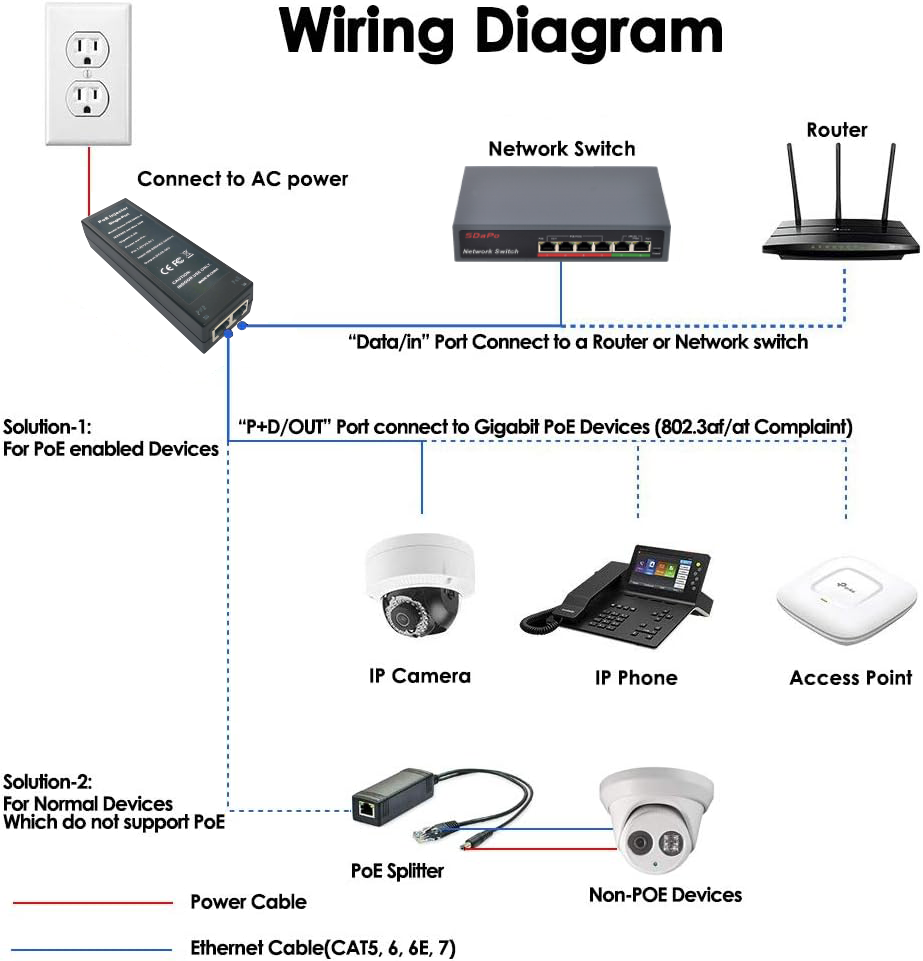
At its core, a PoE injector is a device that allows both electrical power and data to travel over a single Ethernet cable. This means that instead of running two separate cables—one for data (Ethernet) and one for power—only one cable is needed, making installations cleaner, simpler, and more efficient. The injector typically sits between your network switch and the powered device, adding power to the Ethernet data stream and enabling the device to function without a separate power source.
The SDAPO PSE30WG-B Gigabit 30W PoE Injector is a compact and powerful device that fits this role perfectly. It supports both IEEE802.3af (PoE) and IEEE802.3at (PoE+) standards, meaning it can provide up to 30W of power to compatible devices such as IP cameras, wireless access points, and VoIP phones.
The operation of a PoE injector is simple yet powerful:
1. Power input: AC power enters the injector from an electrical outlet (typically with an input voltage range of 100-240VAC).
2. Data input: Network data enters the injector through the Ethernet port from a network switch or router.
3. Combining power and data: The injector combines both power and data, embedding the electrical power into the Ethernet cable.
4. PoE output: The injector sends both power and data over the same Ethernet cable to the powered device. The device receives its required power and data through this single cable.
This streamlined process is ideal for installations in hard-to-reach locations such as ceilings, outdoor environments, or areas with limited access to electrical outlets. The SDAPO PSE30WG-B supports data transmission up to 100 meters, providing both power and data over longer distances.
Traditional power adapters are bulky and require a separate connection to each device, resulting in additional wiring and clutter. On the other hand, PoE injectors offer a much cleaner solution by reducing the number of cables needed. The SDAPO PSE30WG-B injects power directly into the Ethernet cable, which means you only need one cable to provide both power and data to your device.
This is particularly advantageous when installing devices like wireless access points in ceilings or outdoor security cameras. By eliminating the need for separate power lines, PoE injectors reduce installation complexity, decrease labor costs, and improve overall efficiency.
PoE injectors come in two main types: active and passive.
● Active PoE injectors are the most common and provide dynamic power negotiation. They follow IEEE standards, ensuring that the right voltage is supplied to devices that require power. Active PoE injectors, such as the SDAPO PSE30WG-B, automatically adjust the voltage depending on the requirements of the connected device, ensuring compatibility and protection against overcurrent or overvoltage.
● Passive PoE injectors, on the other hand, supply constant voltage (e.g., 24V or 48V) to the device, regardless of the device's power needs. While these are cheaper, they require careful compatibility checks, as using the wrong voltage can damage the device.
The SDAPO PSE30WG-B is an active PoE injector and is ideal for environments where automatic voltage adjustment is needed for different devices.
PoE injectors operate according to IEEE standards, which define the amount of power that can be delivered over Ethernet cables. These standards are:
PoE Standard | Max Power | Typical Applications |
802.3af (PoE) | 15.4W | VoIP phones, basic IP cameras |
802.3at (PoE+) | 30W | Wireless access points, PTZ cameras |
802.3bt (PoE++) | 60-90W | Digital signage, lighting systems |
Each of these standards has different power limits, so it’s important to match your injector with the devices you're using. The SDAPO PSE30WG-B, for instance, supports the IEEE802.3af/at standards, making it ideal for powering devices like wireless access points and security cameras that require up to 30W of power.
PoE injectors power a wide range of devices. Some of the most common devices powered by PoE injectors include:
● IP security cameras
● Wireless access points (WAPs)
● VoIP phones
● Bluetooth access points
● Smart sensors
● IP point servers
The SDAPO PSE30WG-B is designed to power devices like IP telephones, wireless access points, Bluetooth access points, security cameras, and WiMAX access points, all over a single Ethernet cable.
Prompt: When expanding your network, make sure to match the injector’s wattage output with the power requirements of your devices.
PoE switches can be expensive, especially for small installations. If you only need to power a few devices, such as a single security camera or a wireless access point, using a PoE injector is a more affordable solution. The SDAPO PSE30WG-B injector provides 30W of power at a much lower cost than upgrading to a PoE switch.
One of the biggest advantages of PoE injectors is their flexibility. Instead of replacing your entire switch, you can add PoE capability on an as-needed basis. The SDAPO PSE30WG-B injector is perfect for this type of incremental expansion, allowing you to add devices such as IP cameras or wireless access points without overhauling your existing network.
The SDAPO PSE30WG-B is compatible with both 1Gbps and 2.5Gbps Ethernet speeds and integrates seamlessly with most network switches. By connecting the injector to your existing switch, you avoid major network redesigns and can quickly power up your devices.
With the SDAPO PSE30WG-B, you can power your devices over a single Ethernet cable, eliminating the need for multiple power adapters and reducing the overall complexity of the installation. This is especially useful in environments with limited access to power outlets, such as outdoor security cameras or ceiling-mounted access points.
The PSE30WG-B injector simplifies power management by providing a centralized location for power distribution. This makes it easier for IT teams to monitor and manage power usage, as well as perform maintenance on devices.
The PSE30WG-B includes full over-voltage and over-current protection, ensuring that your devices are protected from power surges and electrical faults. This level of protection is crucial for sensitive devices like security cameras and VoIP phones, where power interruptions can lead to system failures.
Before choosing a PoE injector, always verify the power requirements of the devices you're using. For example, the SDAPO PSE30WG-B provides 30W of power, which is ideal for IP cameras, wireless access points, and VoIP phones. If you plan to use devices that require more power, you may need to opt for a higher-wattage injector.
Ensure that the injector supports the appropriate IEEE standard for your devices. The SDAPO PSE30WG-B supports IEEE802.3af/at, which makes it compatible with most wireless access points, security cameras, and VoIP phones. Always match the injector's standard to your device’s power requirements.
One of the most common mistakes when using a PoE injector is not verifying the power requirements of your devices. Each device, whether it’s an IP camera, wireless access point, or VoIP phone, has a specific power requirement. For example, the SDAPO PSE30WG-B PoE injector provides up to 30W of power, which is suitable for many standard devices. However, some devices may require more or less power, depending on their specifications.
Using a PoE injector with insufficient power can lead to several issues, including device instability, slow performance, or even complete device failure. For example, a device that needs 45W might not work properly with a 30W injector, leading to power interruptions or malfunctioning. Conversely, using an injector with excessive power could potentially damage the device if it is not designed to handle the higher wattage.
Before you set up your PoE injector, it’s crucial to check your devices’ power requirements and ensure that the injector can meet those needs. This simple step can save you from unnecessary downtime and equipment failures.
Another mistake is mixing passive PoE injectors with devices that require active PoE. The key difference between these two types is that active PoE injectors automatically adjust voltage to match the connected device’s power requirements, following the IEEE standards. On the other hand, passive PoE injectors provide a fixed voltage, regardless of the device's needs.
Using a passive PoE injector with a device that requires active PoE can cause serious problems. Devices designed for active PoE may not function properly with passive PoE, potentially resulting in power surges, device failure, or even permanent damage. It’s critical to ensure that the injector’s type aligns with the power needs of your devices. Always check the product specifications of both your injector and powered devices to confirm compatibility.
To avoid these mistakes, always ensure that the PoE injector you’re using provides the right amount of power and matches the required power standards for your devices. Doing so will ensure a smooth, reliable installation and minimize risks to your equipment.
Choose the right PoE injector based on your devices' power needs to streamline your network setup and avoid performance issues. Contact SDAPO now for more information on the PSE30WG-B PoE Injector and how it can enhance your network’s performance.
A: A PoE injector is a device that combines electrical power and data into a single Ethernet cable, allowing powered devices like IP cameras and access points to receive both power and data over one cable.
A: A PoE injector connects to a network switch and injects power into the Ethernet cable, delivering both data and power to the connected device, simplifying network installations.
A: PoE injectors are more affordable and suitable for smaller installations, while PoE switches are ideal for larger networks that require multiple powered devices.
A: Yes, PoE injectors like the SDAPO PSE30WG-B are suitable for outdoor cameras, as they provide both data and power over a single cable, simplifying the installation process.
A: Yes, PoE injectors are energy-efficient as they use low-voltage power delivery, minimizing energy consumption while still delivering enough power for devices like security cameras and phones.


