
5F, W2, Chengxin Building , Tian An Shen Chuang Valley Industrial Center, Fenggang Town, Dongguan City, Guangdong Province,China 523681
Views: 0 Author: Site Editor Publish Time: 2026-02-09 Origin: Site


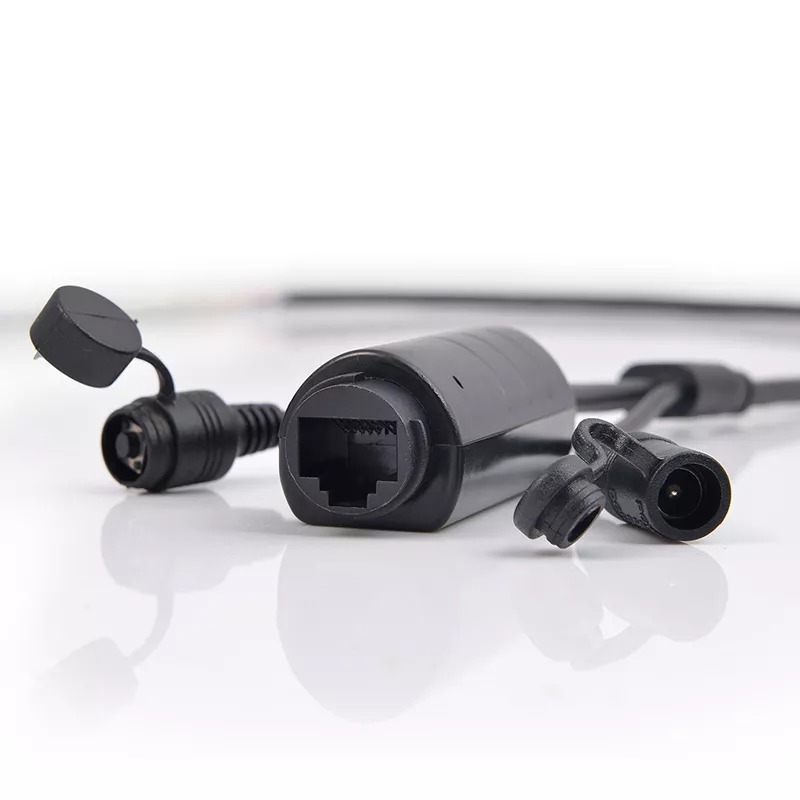
If you’ve ever searched “Is PoE cable the same as Cat6?”, you’re not alone. Many buyers, especially IT managers and system integrators, often confuse cable categories with PoE functionality. The short answer is simple: a PoE cable is not a separate cable type. It’s usually a standard Ethernet cable—most commonly Cat6—used to deliver both data and power at the same time.
In this article, we explain the difference in practical terms. You’ll learn how PoE works, why Cat6 is widely used in PoE deployments, and how to choose the right cable for real-world projects, from smart building systems to IoT applications.
Power over Ethernet (PoE) isn’t a special cable type—it’s a technology. It sends both data and electric power through one Ethernet line. That line? Usually just a regular Cat5e, Cat6, or Cat6a cable. There's no such thing as a cable labeled “PoE cable” in official specs. Instead, it’s all about how the cable’s built and how it’s used.
PoE lets devices like these work without wall power:
● Smart sensors in factories
● Smart terminals in offices
● IoT devices in warehouses
● VoIP phones on desksIf a cable can handle both power and data—safely, consistently, and within standards—then it’s considered suitable for PoE. The term “PoE cable” just reflects its job, not its category.
PoE doesn’t rely on any special “PoE-only” cable. Instead, it runs on regular twisted‑pair copper Ethernet cables. What really matters is conductor quality, wire gauge, and overall cable construction—not the label on the jacket.
In most real deployments, PoE commonly works over the following cable categories:
Cable Type | Typical Use in PoE | Key Characteristics |
Cat5e | Basic PoE devices | Supports standard PoE and PoE+, suitable for lower power loads and shorter runs |
Cat6 | Most modern PoE setups | Thicker copper conductors, better heat control, cleaner data under power |
Cat6a and above | High‑power or dense PoE networks | Enhanced shielding and thermal performance, ideal for PoE++ and bundled installations |
Simply put, PoE performance depends on how well the cable is built—not on whether it’s marketed as a “PoE cable.”
In practice, “PoE cable” is shorthand for a properly rated Ethernet cable used in PoE systems. The phrase sticks because buyers care about outcomes: stable power, clean data, and long-term reliability.
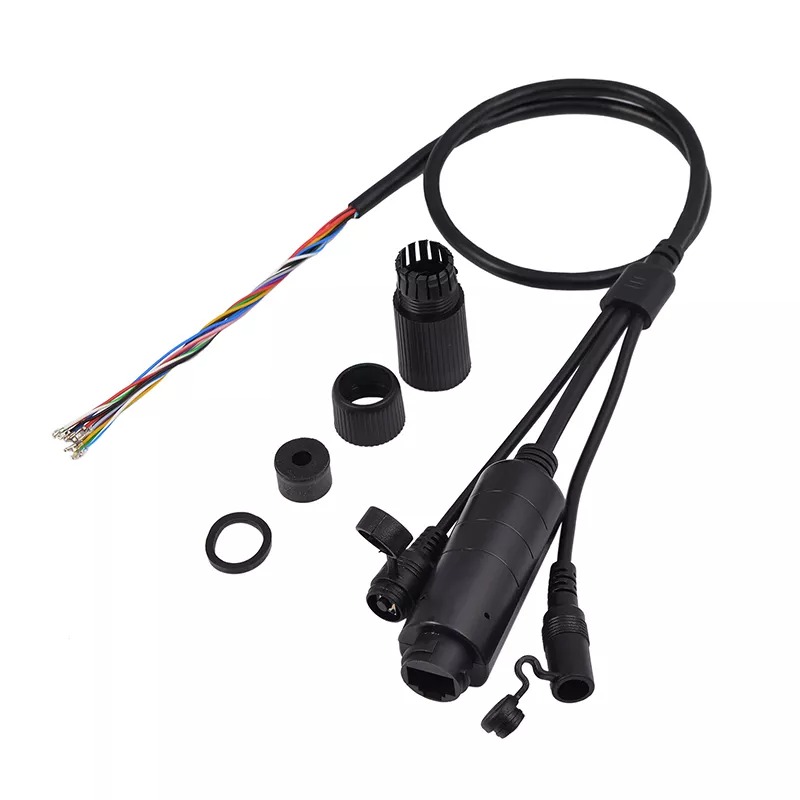
Cat6 improves on Cat5e by upgrading both internal structure and electrical performance. These changes focus on lowering interference and resistance, which helps ensure cleaner data signals and more stable power delivery in PoE environments.
Feature | What’s Improved | PoE Benefit |
Tighter twists | Denser pair winding | Less signal noise |
23 AWG copper | Thicker conductors | Lower resistance, better power flow |
Reduced crosstalk | Improved pair isolation | Cleaner data under load |
Central spline | Physical pair separation | More stable performance |
These core design upgrades explain why Cat6 is widely chosen for modern PoE installations.
Cat6 supports:
● 250 MHz bandwidth
● Up to 10 Gbps (short runs)
● 1 Gbps at full 100 m
More importantly for PoE, its thicker copper conductors help reduce heat buildup and voltage drop. This improves power stability, especially in continuous operation or bundled cable installations.
Commercial networks increasingly demand:
● Higher power delivery
● Faster data rates
● Dense cable bundles
Cat6 meets all three while maintaining signal quality and thermal control. That’s why it has become the default choice in offices, factories, smart buildings, and growing IoT environments.
Cat6 is not born a PoE cable. It becomes one when used to deliver PoE.
In other words:
● Cat6 = cable specification
● PoE cable = application role
When Cat6 carries PoE power, people call it a PoE cable.
Not all Cat6 cables perform the same under PoE. Even when they share the same category label, real-world results can vary widely based on material and construction details. That’s why simply buying “Cat6” is often not enough for stable PoE performance.
Factor | What Changes | Impact on PoE |
Copper purity | Solid copper vs CCA | Affects heat and power stability |
AWG thickness | Thicker vs thinner cores | Influences voltage drop |
Shielding | Shielded or unshielded | Impacts interference resistance |
Manufacturing quality | Process consistency | Determines long-term reliability |
These factors explain why two Cat6 cables can behave very differently once power starts flowing.
Low-cost Copper-Clad Aluminum (CCA) cables often overheat and lose voltage under load. Solid bare copper performs far better.
Manufacturers like Sdapo focus specifically on PoE-related products and testing, using pure copper conductors and validating performance through surge, aging, and thermal stress processes. This matters when devices run 24/7.
Cat6 typically uses 23 AWG copper, which lowers resistance. Less resistance means:
● Reduced voltage drop
● Higher usable power at the device
● Cooler cable bundles
PoE generates heat inside cables. In large installations—dozens or hundreds of bundled runs—thermal buildup becomes a real design factor.
Cat6 dissipates heat more effectively than Cat5e, making it safer for PoE+ and PoE++ deployments.
Cat6 comfortably supports:
● PoE (802.3af – 15.4W)
● PoE+ (802.3at – 30W)
● PoE++ (802.3bt – up to 100W)
This enables high-power devices like digital signage, smart lighting, and IoT control systems.
Cat6 cables are built with tighter twist density and better internal separation, which significantly reduces crosstalk between pairs. This ensures that data transmission remains clean and consistent, even while electrical power flows through the same cable. Such reliability is especially critical for high-bandwidth applications like smart building systems, VoIP calls, and enterprise-grade networks operating under PoE.
PoE Type | IEEE Spec | Power Output | Typical Devices |
PoE | 802.3af | 15.4W | VoIP phones, basic control panels |
PoE+ | 802.3at | 30W | Multi-radio sensors, smart lighting |
PoE++ (Type 3) | 802.3bt | 60W | Digital signage, industrial IoT devices |
PoE++ (Type 4) | 802.3bt | 90–100W | Access control, smart lighting, switches |
As power increases, voltage drop becomes a major concern. Cat6’s lower resistance helps maintain voltage across long runs.
Some brands—like Sdapo—optimize their cable builds to support these standards fully. Their cables go through high-low temperature cycling, ensuring they perform across real-world conditions.
Cat6 cables have lower electrical resistance, which helps keep voltage stable even over extended distances. This voltage consistency becomes essential when supporting higher wattage devices in PoE+ and PoE++ applications, where power delivery must remain reliable across long cable runs.
At PoE++ levels, every watt of power becomes critical. Thicker Cat6 conductors reduce energy loss and deliver more usable power to endpoint devices compared to thinner-gauge cables. This ensures better device performance, especially in high-load or multi-device environments.
Cat5e is still a practical choice in many basic scenarios. It works well for devices such as:
● Basic VoIP phones
● Simple control panels
● Low-power sensors
These applications are typically low-bandwidth and low-wattage, especially when installed on short, unbundled cable runs where heat and voltage drop aren’t major concerns. In such cases, Cat5e delivers acceptable performance without requiring an infrastructure upgrade.
Cat6, however, brings several future-ready advantages. It offers:
● Headroom for PoE++
● Support for faster networks
● Longer service life
Because Cat6 supports both higher power and faster data, it avoids costly rework later. Pulling new Cat5e today often leads to an avoidable upgrade cycle tomorrow as demands grow.
Not all Cat6 is created equal. You need to verify the materials and compliance standards before installing it into a PoE network. Many budget cables use CCA, which looks like copper—but performs poorly.
Here’s what to check:
Attribute | What You Want |
Conductor Material | Solid bare copper (not CCA) |
AWG Rating | 23 AWG |
Standards Supported | IEEE 802.3af/at/bt, ISO/IEC 11801 |
Certifications | CE, FCC, RoHS, ISO 9001 |
Jacket Markings | Clear print showing Cat6 + specs |
Manufacturers like Sdapo not only meet these standards—they test for them in actual lab environments. They use ESD probes, surge generators, and aging ovens to validate cable strength.
Look beyond the label. Ask for spec sheets. Ask about internal testing. A good Cat6 cable will pass scrutiny.
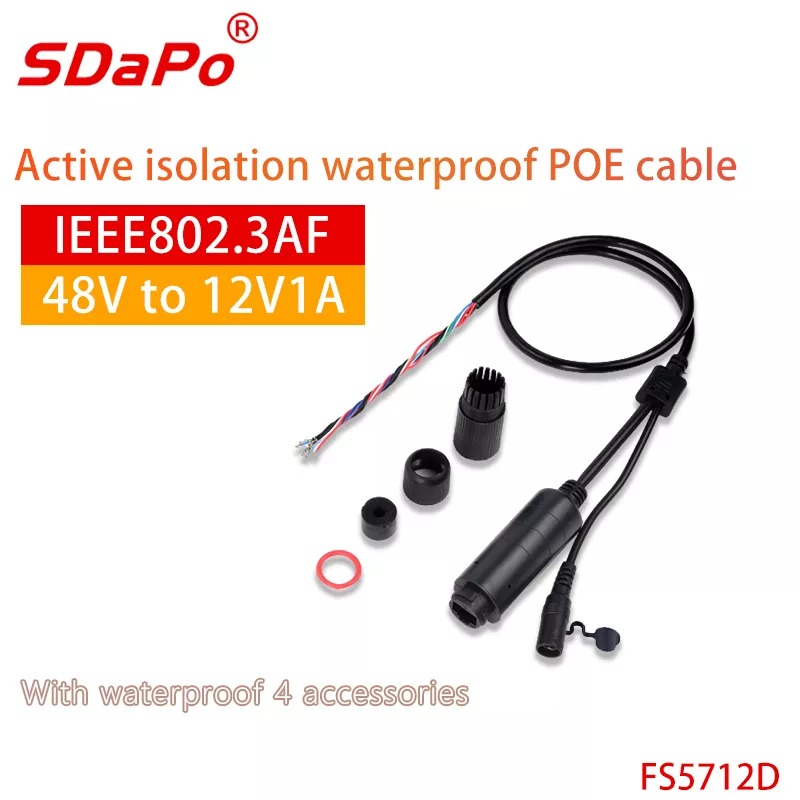
So, is PoE cable the same as Cat6? Not exactly. PoE cable describes how a cable is used. Cat6 defines how it is built. Cat6 stands out because it offers thicker copper, better heat control, strong support for high‑power PoE++, and cleaner data under load.
When sourced from experienced suppliers like Sdapo Communication Co.,Ltd, Cat6 becomes a reliable PoE cable for smart building systems, IoT control terminals, and enterprise automation. Their PoE-focused products deliver stable power, consistent performance, and practical value for modern network projects.
A: Not exactly. A PoE cable describes how the cable is used, while Cat6 defines how it’s built. Cat6 simply provides a strong physical foundation for PoE.
A: A PoE cable is a standard Ethernet cable carrying both power and data. It’s usually Cat6 or Cat5e, as long as it meets electrical and safety requirements.
A: Yes. Cat6 works very well as a PoE cable because its thicker copper reduces heat and voltage drop, which helps devices run more reliably.
A: Cat6 handles higher power levels, manages heat better, and keeps cleaner data signals, especially in bundled installations or PoE++ setups.
A: There’s usually no separate price for “PoE cable.” Cost depends on Cat6 quality. Solid copper Cat6 costs more than CCA, but delivers safer power and longer service life.
A: First confirm your PoE cable uses solid copper, supports the required PoE standard, and isn’t too long. Poor cable quality is a common cause of power issues.


